Networks are not essential for PINNs: A network-free piecewise parametric optimization framework

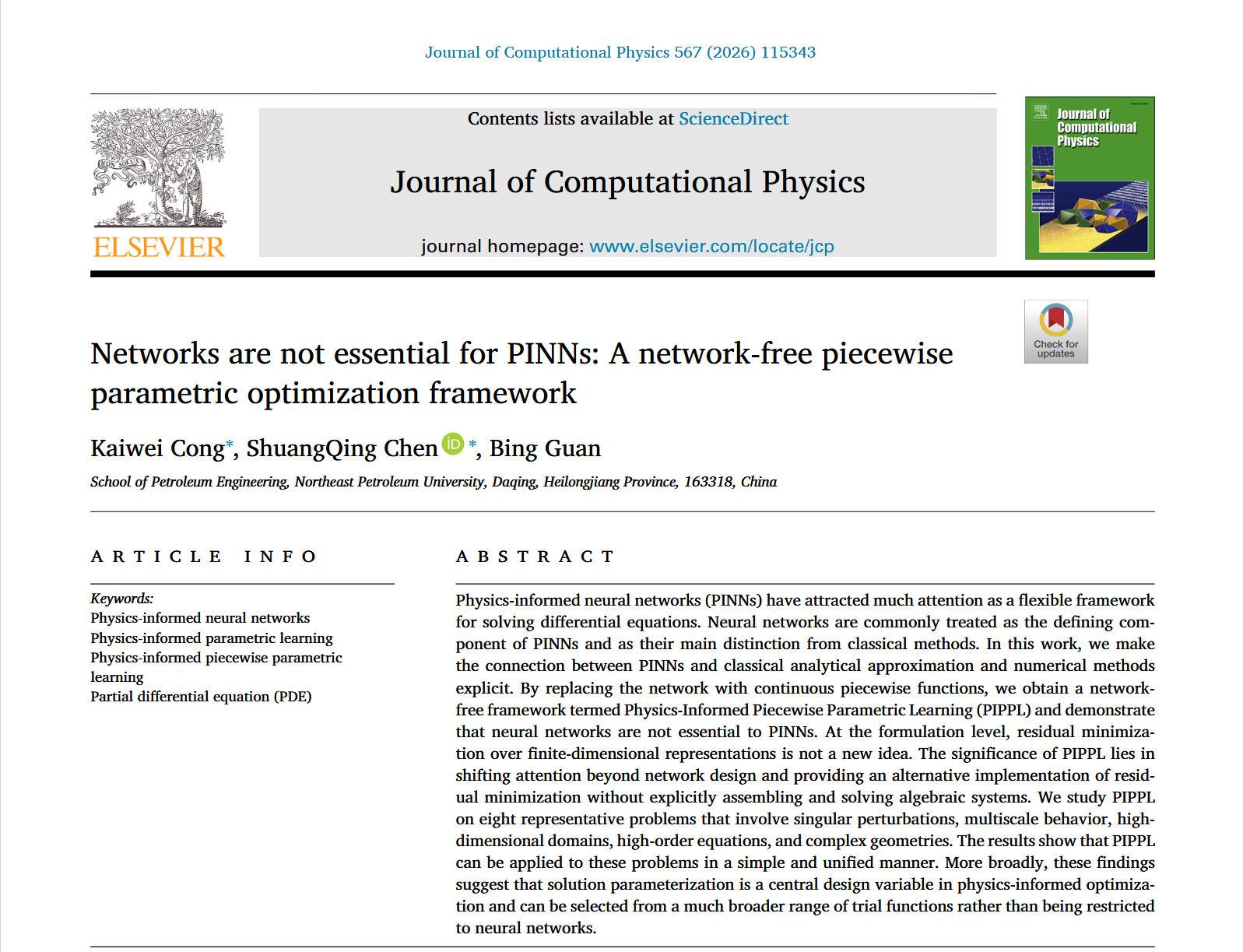
这是一篇讨论性质的论文,从论文的标题就可以看出,论文标题为“网络并非PINNs的必需:PINN是一种无网络分段参数优化框架”。
我们先来看看这篇论文的摘要:
摘要
英文原文:
Physics-informed neural networks (PINNs) have attracted much attention as a flexible framework for solving differential equations. Neural networks are commonly treated as the defining component of PINNs and as their main distinction from classical methods. In this work, we make the connection between PINNs and classical analytical approximation and numerical methods explicit. By replacing the network with continuous piecewise functions, we obtain a networkfree framework termed Physics-Informed Piecewise Parametric Learning (PIPPL) and demonstrate that neural networks are not essential to PINNs. At the formulation level, residual minimization over finite-dimensional representations is not a new idea. The significance of PIPPL lies in shifting attention beyond network design and providing an alternative implementation of residual minimization without explicitly assembling and solving algebraic systems. We study PIPPL on eight representative problems that involve singular perturbations, multiscale behavior, highdimensional domains, high-order equations, and complex geometries. The results show that PIPPL can be applied to these problems in a simple and unified manner. More broadly, these findings suggest that solution parameterization is a central design variable in physics-informed optimization and can be selected from a much broader range of trial functions rather than being restricted to neural networks.
翻译:
物理知情神经网络(PINN)作为一种灵活的微分方程求解框架,备受关注。神经网络通常被视为PINNs的定义成分,也是其与传统方法的主要区别。在本研究中,我们明确阐明了PINNs与经典解析近似及数值方法之间的联系。通过用连续分段函数替代网络,我们得到了一个无网络的框架,称为物理知情分段参数学习(PIPPL),并证明神经网络并非PINNs的必需。在表述层面,有限维表示的残差最小化并非新思想。PIPPL的重要性在于将注意力从网络设计转向,提供一种在不明确组装和求解代数系统的情况下实现残差最小化的替代方法。我们研究PIPPL涉及奇异扰动、多尺度行为、高维域、高阶方程和复几何的八个代表性问题。结果表明,PIPPL可以简单统一地应用于这些问题。更广泛地说,这些发现表明解参数化是物理驱动优化中的核心设计变量,可以从更广泛的试验函数中选择,而非局限于神经网络。